
You know that moment when you think you’re doing fine, then a bill hits, or your bank app sends a low-balance alert at the worst possible time? It’s not always “bad with money.” A lot of the time, it’s a few small budgeting mistakes that repeat on autopilot.
Most budgeting problems aren’t about willpower. They’re about missing systems. Tiny leaks, skipped check-ins, unrealistic targets, and zero room for real life.
One reason this matters is that many people simply don’t review their budgets often. There isn’t one official 2025 to 2026 national stat for “reviewed your budget in the last 30 days,” but older industry surveys and summaries commonly place monthly budget reviews at around 30%. That gap explains why budgets “fail” even when the plan looked smart on day one.
This guide uses simple language and practical steps. You’ll walk away with the most common budgeting mistakes and clear fixes, plus a quick plan you can start today.
Budgeting Mistake: You do not track spending, so money leaks out
Tracking doesn’t mean judging yourself. It just means checking where money went so you can make better calls next week.
In real life, spending is easy to miss because so much is frictionless now. Tap-to-pay, subscriptions, app stores, food delivery, and “one more add-on” at checkout make spending feel invisible. When you don’t track it, your budget turns into a guess.
A simple way to reset is a 7-day spending check:
- Review the last 7 days of transactions (bank, credit cards, payment apps).
- Label each one with a category (groceries, gas, eating out, bills, shopping, subscriptions).
- Add up totals, then list your top 5 categories by dollars spent.
- Pick one category to tighten for the next 7 days, not ten categories at once.
The “small purchases” trap (coffee, apps, delivery) and how to cap it
Small purchases are the budget’s slow drip. One coffee doesn’t hurt. Neither does a $6 add-on, a $12 lunch “because it’s been a long day,” or a $9.99 subscription you forgot about. The issue is the pattern.
A quick way to see it: $15 a day in “little stuff” is about $105 a week. That’s often the difference between “I can’t save” and “I can save.”
One of my favorite quotes is by Benjamin Franklin. I’ve included it in my 99 Best Motivational Quotes for Success. Here it goes:
“Beware of little expenses; a small leak will sink a great ship” – Benjamin Franklin
Try this fix for one month:
Set a fun money limit: Choose a weekly amount you can spend without guilt (coffee, snacks, apps, impulse buys). When it’s gone, it’s gone.
Track every under-$20 purchase: Yes, all of them. The point isn’t shame, it’s visibility. This one habit changes spending fast.
Turn off one-click checkout: Make spending slightly annoying again. That friction works.
Use a 24-hour wait rule: For non-essentials, wait a day before buying. If you still want it, plan for it.
I once had a friend with such a need for spending impulse control that she kept her credit card frozen in a block of ice in the freezer. Needless to say, this is extreme and unlikely to apply to most of us, but it reflects a commitment to taking control of one’s money.
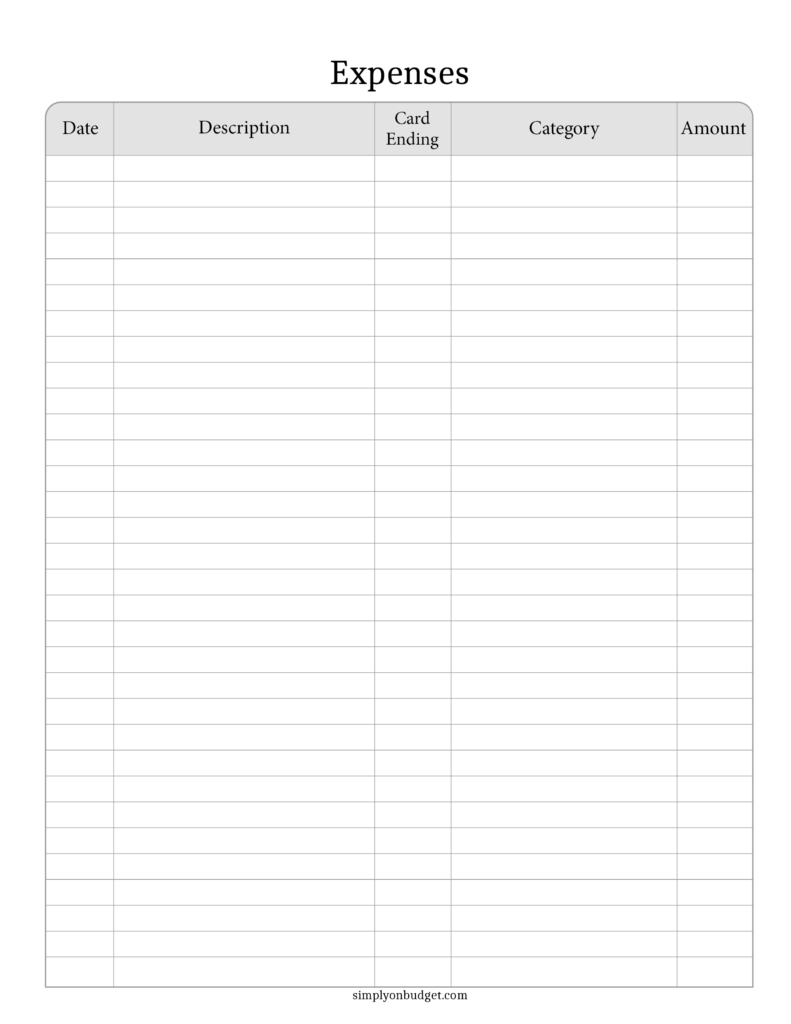
If you need a quick printable for tracking your monthly expenses, here is a freebie I made for you. It’s a page I created for my The Ultimate Mom Daily Planner to help me stay organized and track tasks. The pdf is included below as well.
Skipping budget check-ins: why a budget you do not review does not work
A budget is like a grocery list. Writing it once doesn’t stop you from impulse-grabbing snacks at the store. You need to review it again.
The simplest habit that actually sticks is a weekly “money day.” Set a timer for 15 to 20 minutes. Same day every week. Same place if you can.
Use this quick checklist:
- Check category totals (groceries, eating out, gas, shopping).
- Scan for new subscriptions or free trials that started charging.
- Look for price increases (insurance, streaming, utilities).
- Confirm upcoming bills before they hit.
- Make one small adjustment for next week.
This is also where most people fall off. When you don’t review your plan, you can’t correct course. A budget with no check-ins is like driving with your eyes half closed.
So, it really is as simple or as hard as adding it to your monthly planner, as an action item to “Review Budget,” once a month at minimum.
And of course, the way you track your expenses will vary, whether you use an app, a spreadsheet, or write things down on paper. For spreadsheets, we have a great Simple Expense Tracker spreadsheet which works in Google sheets, and can be accessed on your phone through your gmail account.
Budgeting Mistake: Your budget is unrealistic (too strict, outdated, or missing real costs)
A “perfect” budget is the fastest way to quit. If your plan assumes you’ll cook every meal, never buy gifts, never need a haircut, and never have a bad day, it’s not a budget. It’s a fantasy novel.
The fix is simple: use real numbers. Pull the last 2 to 3 months of transactions, base your categories on what you actually spend, and adjust from there.
Prices also move. Groceries, utilities, insurance, and repairs have all been volatile in recent years. An old budget can become outdated without you noticing. A good budget is flexible. Progress beats perfection.
Forgetting irregular expenses (car repairs, holidays, medical, taxes) and getting surprised
Irregular expenses aren’t rare. They’re just not monthly. And that makes them easy to ignore until they show up like a surprise pop quiz.
Actually, I wholeheartedly hate irregular expenses. They have messed up my budget more times than I can remember. Having lived in Europe and in the Middle East, where expenses are much more ‘monthly’, the irregular expenses of living in North America can really get you. From paying house taxes, credit cards, heating bills, and car registrations, these nasty surprises have bothered me for years. I finally got things together and made a very useful tool which I actually use regularly – a Bill Calendar, which has irregular expenses as its own category.
The fix is a “sinking fund,” which is just a plain way of saying: save a little each month for known future costs.
Here’s how to set it up:
- List your yearly and seasonal expenses (car maintenance, gifts, back-to-school, annual subscriptions, medical copays). Don’t forget annual subscriptions, taxes, car registrations, or anything else that isn’t billed monthly.
- Estimate the annual total for each category.
- Divide by 12.
- Save that amount monthly in a separate savings account (or labeled bucket).
A few common examples just to give you an idea:
| Expense (example) | Annual estimate | Monthly sinking fund |
| Car maintenance and tires | $900 | $75 |
| Holiday gifts and travel | $1,200 | $100 |
| Medical and prescriptions | $600 | $50 |
| Home repairs and upkeep | $1,000 | $83 |
These numbers will be different for everyone. What matters is the habit. Once sinking funds are in place, “random” expenses stop feeling random.
Planning monthly totals, but ignoring timing (paydays vs. due dates)
Even if the math works on paper, timing can still break your budget. This is how people overdraft while technically having “enough money” that month.
Cash flow is the schedule of money in and money out. If your rent is due on the 1st but you get paid on the 5th, your budget can be correct and still fail in real life.
Fix it with a 20-minute timing audit:
- Write down paydays for the next month.
- List bill due dates (rent, car payment, insurance, phone, subscriptions).
- Put them on one calendar view (our Bill Calendar does that automatically, which is why it’s so awesome).
- Move due dates when possible (many lenders let you choose).
- Keep a small buffer in checking if you can (even $100 helps).
Think of it like traffic. The road may be clear, but if you leave late, you still miss the flight.
Budgeting Mistake: You skip the safety net, then debt becomes the backup plan
When you don’t have a safety net, every surprise gets funded by a credit card, buy now pay later, or a loan. Then the next month’s budget has to carry last month’s problem.
This isn’t a character flaw. It’s a system issue. Without savings, debt becomes your emergency fund, and that’s an expensive way to live.
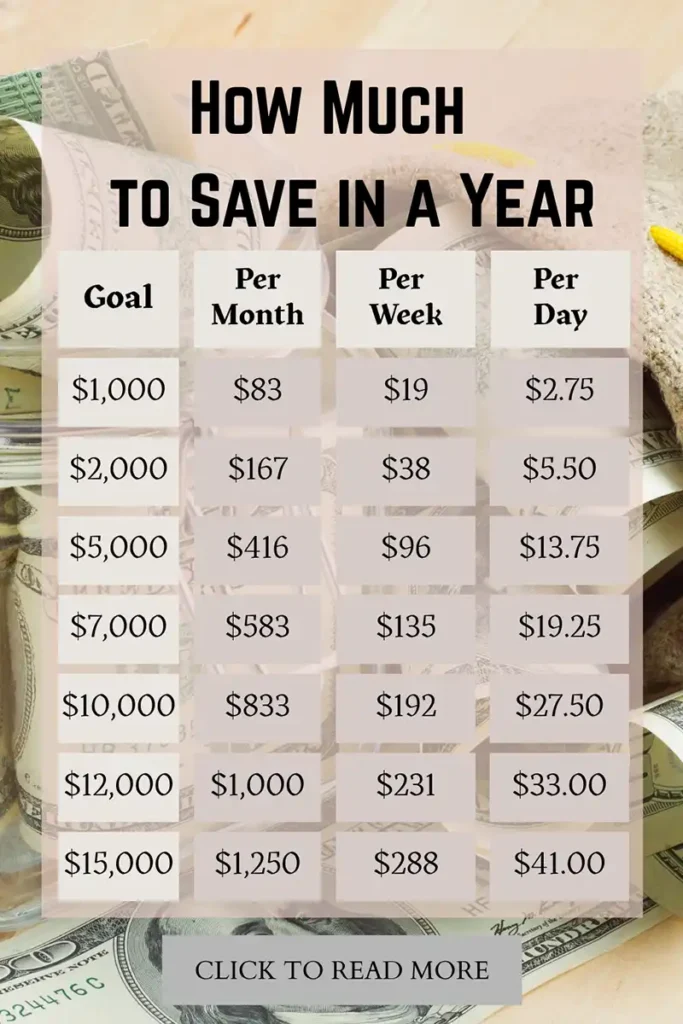
Most personal finance guidance starts with a small target, often $500 to $1,000, then builds from there. The exact number isn’t magic. The point is creating separation between “something went wrong” and “now I’m behind for three months.”
No emergency fund: how to start saving when money is tight
If money is tight, saving can feel like trying to scoop water out of a sinking boat. Start anyway, but start small.
I actually wrote a great article a while back: How to Save an Emergency Fund Fast.
Here’s a starter plan that works in the real world:
Automate a small amount per paycheck: Even $10 to $25 adds up. The win is consistency.
Try split direct deposit: If your employer supports it, send a small portion straight to savings so you don’t have to think.
Save before optional spending when possible: Not “save everything first,” just “save something first.” A tiny transfer can protect you from big stress later.
A simple goal ladder:
- First goal: $500
- Next goal: $1,000
- Then: one month of essential bills
- Later: 3 to 6 months, depending on your job stability and household needs
Not saving for planned expenses
A lot of people label everything as an “emergency.” Then they feel like they’re always in crisis mode.
Planned expenses aren’t emergencies, even if they’re annoying. Car tires wear out. Oil changes happen. Home repairs show up. If you own a home, something will break; it’s not a surprise, it’s a calendar event that didn’t get scheduled.
Treat planned expenses as sinking funds, not emergencies. Your emergency fund is for true surprises, like a job loss, an urgent medical bill, or a sudden travel need for family.
Note the overlap with irregular expenses. Each person has a different situation, so it’s a good idea to sit down and list all expenses that are not monthly. Then it’s much easier to start classifying them, and set up sinking funds for them (or saving buckets).
Once you separate these buckets, budgeting becomes more manageable quickly.
Budgeting Mistake: You do not plan for change (raises, inflation, and lifestyle creep)
Budgets fail when life changes, and the plan stays frozen. Raises happen. Prices go up. Kids grow. Insurance renews. Your budget has to move with your life.
The sneakiest change is lifestyle creep, spending more because you can. It usually shows up as new monthly payments: a nicer car, higher rent, more subscriptions, more delivery, upgrades everywhere. It feels harmless until it locks your money into fixed costs.
Lifestyle creep after a raise: a simple rule that still lets you enjoy money
A raise is exciting, but it can also disappear in a month if you don’t give it a job.
Try a simple split: allocate 50% of the raise to goals (debt payoff, emergency fund, retirement, sinking funds) and 50% to lifestyle (fun, upgrades, convenience).
This rule lets you enjoy your money without letting it run your life.
One caution: be careful with new fixed costs. A one-time splurge is easier to undo than a new payment. I wrote a great article on the Dangers of Buy Now, Pay Later. The gist of the article is that if you’re going to enroll in a BNPL, make sure you add it to your budget as an expense for the duration of the term, or you risk living above your means or blowing your budget.
A good test question before adding a new monthly bill: Could you still afford this if your income dropped for three months? If the answer is no, pause and re-check.
Inflation proofing your budget: how to update categories without feeling broke
Inflation proofing doesn’t mean you’re failing. It means you’re paying attention.
Do a quarterly check-in that takes 10 minutes:
- Look at the last 3 months of groceries, gas, and utilities.
- Compare the averages to your budgeted amounts.
- If a category is consistently higher, raise it.
- Cut the same amount from a lower priority area, so you don’t rely on credit.
A few practical ways to make room without feeling punished:
- Meal plan 3 to 4 dinners a week, keep the rest simple.
- Buy store brands for staples you use often.
- Shop with a list, and don’t browse hungry.
- Limit deliveries to a set monthly limit, then make it an event.
You’re not trying to “win” at budgeting. You’re trying to make your money match your real life.
Conclusion
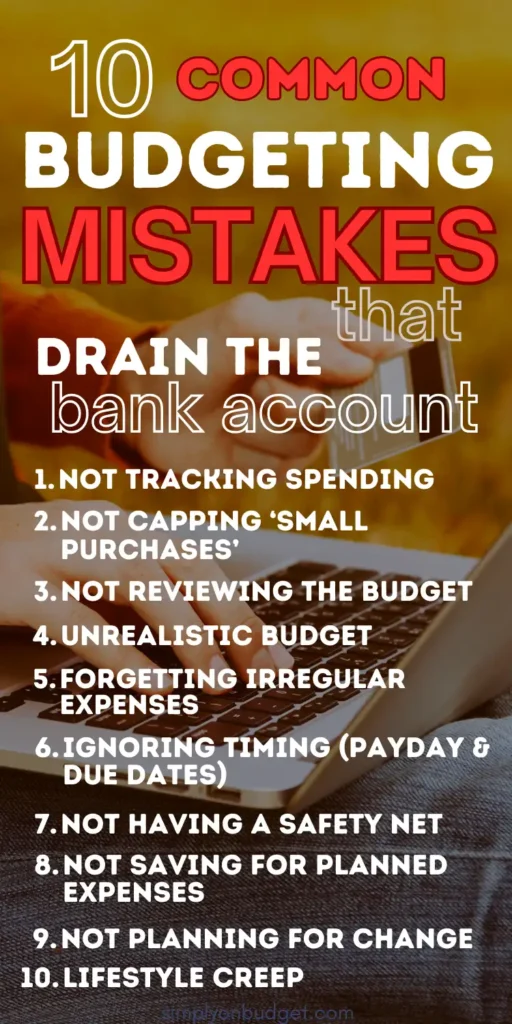
Budgeting works when it’s reviewed, realistic, and built for real-world conditions, not best-case scenarios. The big mistakes are simple: not tracking spending (fix it with a 7-day reset), letting small purchases stack up (cap fun money), skipping check-ins (schedule a weekly money day), making the budget too strict (use real numbers), forgetting irregular expenses (set sinking funds), ignoring cash flow timing (align paydays and due dates), skipping a safety net (start small), and not planning for change (control lifestyle creep and update for prices).
Today’s plan: pick a tool (app or spreadsheet), schedule one weekly money day, create one sinking fund, and automate a small savings transfer. Choose one change this week, not ten, and let that one win, build momentum.